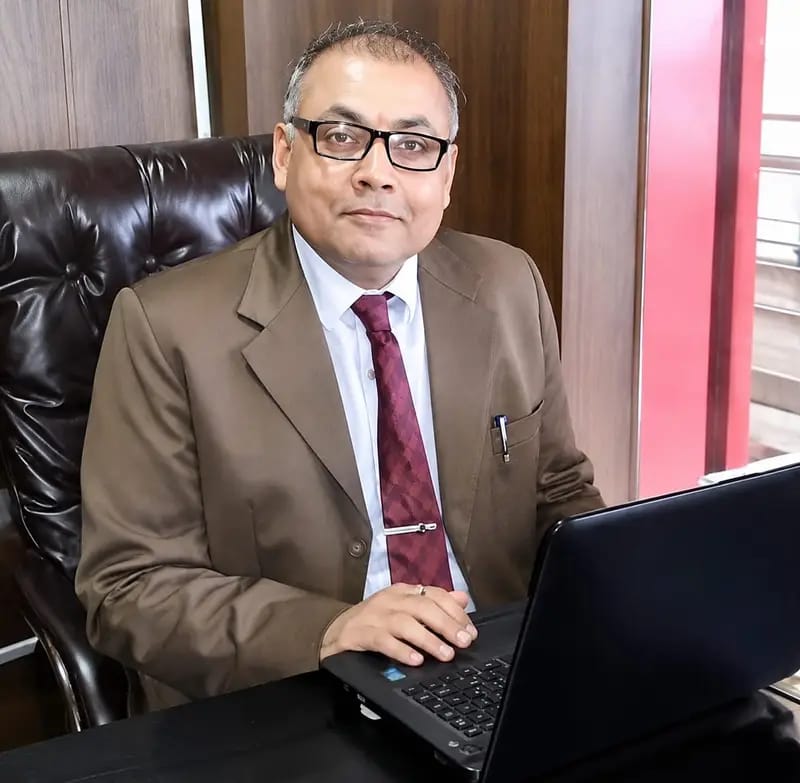


Pradip Chakraborty
Senior Engineering Associate (Mechanical) | Scientific Instrumentation Specialist | Opto-Mechanical Engineer | Research Contributor
Pradip Chakraborty is an accomplished Indian mechanical engineering professional, scientific instrumentation specialist, researcher, and technical contributor whose career spans more than 36 years across precision engineering, manufacturing, tool and die technology, production management, and astronomical instrumentation.
He currently serves as Senior Engineering Associate (Mechanical) at the Aryabhatta Research Institute of Observational Sciences (ARIES), an autonomous research institute under the Department of Science & Technology, Government of India. Through his work at ARIES, Chakraborty has built a distinctive professional identity at the intersection of mechanical engineering and observational astronomy, contributing engineering expertise to sophisticated telescope systems, scientific instruments, mirror-support infrastructure, and observatory development.
His professional journey is distinguished not merely by longevity, but by its remarkable breadth. From conventional manufacturing floors and automotive maintenance environments to precision tool rooms and advanced astronomical research facilities, he has worked across diverse engineering settings while continuously expanding his technical and academic capabilities.
Over the decades, Chakraborty's work has encompassed opto-mechanical system design, precision manufacturing, tool and die development, CAD/CAM, CNC programming, production planning, quality management, telescope infrastructure, primary mirror aluminizing support systems, wedge clamp fixtures, and observatory dome development.
His career represents the evolution of a mechanical engineer from the foundations of hands-on manufacturing and tooling to highly specialized engineering applications supporting modern astronomical science.
Early Professional Foundation
Pradip Chakraborty's professional career began in an era when precision engineering depended heavily upon the craftsmanship, practical knowledge, and judgment of engineers and tool makers.
In 1989, he joined IFB Industries Ltd as a Junior Engineer .
During his tenure from 1989 to 1991, he worked on the design and development of precision tools, jigs, and fixtures. His responsibilities also included supporting prototype trials and quality-testing activities.
This early exposure provided him with an important foundation in manufacturing accuracy, tooling methodology, inspection, production discipline, and practical problem-solving.
The experience would later become highly relevant as his career progressed toward increasingly complex engineering systems.

Experience with South Bengal State Transport Corporation
In 1991, Chakraborty joined the South Bengal State Transport Corporation, Government of West Bengal, where he served as Assistant Foreman (Tech-II) until 1996.
This phase broadened his engineering experience beyond tooling and precision manufacturing.
He supervised the maintenance, repair, and overhauling of engines and associated mechanical systems, gaining substantial practical exposure to mechanical maintenance, fault identification, repair procedures, operational reliability, and workforce supervision.
Working within a large transport organization also strengthened his understanding of maintenance management and the importance of keeping engineering assets operational under demanding conditions.
Patton Electro Ltd
From 1996 to 2000, Chakraborty worked with Patton Electro Ltd as a Production Supervisor (Tool Maker).
His responsibilities involved fabrication, assembly, process control, and compliance with established quality standards.
During this period, his engineering and process-improvement efforts contributed to an approximately 18% reduction in rework.
This achievement reflected an approach that would remain visible throughout his later career: engineering should not only produce a technically correct component but should also improve repeatability, efficiency, reliability, and quality.
Manaksia Ltd
A significant progression in Chakraborty's industrial career came with Manaksia Ltd, where he worked between 2000 and 2004 as an Engineer / Chief Mechanical Engineer.
His responsibilities included designing press tools and molds for high-volume manufacturing environments.
He also worked toward standardizing CNC setups and manufacturing procedures.
According to the professional information provided, these improvements resulted in an approximately 15% increase in production efficiency.
The role strengthened his expertise in production engineering and brought together several areas of his professional knowledge, including tooling, machining, manufacturing systems, process optimization, and engineering management.
Hindusthan National Glass & Industries Ltd
Between 2004 and 2006, Chakraborty served as Senior Engineer – Tool Room & Production at Hindusthan National Glass & Industries Ltd.
He managed CNC tooling operations as well as mold and die fabrication activities.
An important aspect of this phase was his involvement with Total Productive Maintenance (TPM) and quality-management systems.
Through the implementation of TPM practices, machine downtime was reportedly reduced by approximately 25%.
He was also involved in ISO audits, further strengthening his knowledge of structured quality systems, documentation, process control, and continuous improvement.
By this point in his career, Chakraborty had developed substantial expertise across tool rooms, production environments, CNC manufacturing, quality systems, and maintenance management.
The next chapter would take this industrial experience into the field of scientific research.
Career at Aryabhatta Research Institute of Observational Sciences (ARIES)
In 2006, Pradip Chakraborty joined the Aryabhatta Research Institute of Observational Sciences (ARIES), where he presently serves as Senior Engineering Associate (Mechanical).
His association with ARIES represents one of the most defining phases of his professional career.
At the institute, mechanical engineering is not limited to conventional industrial production. It becomes an enabling discipline for sophisticated astronomical research.
Modern observatories and telescopes require exceptionally accurate mechanical structures, support mechanisms, fixtures, domes, positioning systems, precision components, and specialized engineering infrastructure. Even highly advanced optical systems ultimately depend on mechanical structures capable of maintaining alignment, stability, repeatability, and reliability.
Chakraborty's work has therefore focused on the important interface between mechanical engineering, precision instrumentation, and astronomy.
He has contributed to the design and fabrication of opto-mechanical instruments for optical telescopes and has supervised or directed CNC machining and tool-room operations supporting scientific instrumentation.
His responsibilities have also included ISO 9001-related quality processes. According to the supplied professional record, these efforts contributed to an approximately 20% reduction in defects and rework.
Expertise in Telescope and Observatory Engineering
One of the most distinctive features of Pradip Chakraborty's professional profile is his specialization in engineering applications associated with astronomical telescopes.
His technical interests and contributions encompass areas such as:
Opto-Mechanical System Design, Precision Instrumentation, Primary Mirror Aluminizing Support Systems, Telescope Mechanical Infrastructure, Wedge Clamp Fixture Design, Observatory Dome Design, Tool & Die Engineering, CAD/CAM, CNC Programming, and Precision Manufacturing.
These areas require a combination of traditional mechanical engineering fundamentals and an understanding of the unusually demanding requirements of scientific instruments.
His work demonstrates how mechanical engineering forms an essential technological foundation for observational astronomy.
A telescope may ultimately be designed to observe extremely distant objects in the universe, but its scientific capability depends on highly precise engineering here on Earth. Mechanical stability, structural accuracy, reliable fixtures, mirror-handling mechanisms, and carefully engineered observatory infrastructure all contribute to the quality and reliability of astronomical observations.
This relationship between mechanical engineering and astronomical research has consequently become an important theme of Chakraborty's technical writings and publications.
Contribution to Primary Mirror Aluminizing Engineering
Among the specialized areas associated with Chakraborty's work is the mechanical engineering involved in the M1 primary mirror aluminizing process of the 3.6-metre Devasthal Optical Telescope.
Large astronomical mirrors require specialized engineering systems for handling, supporting, positioning, and maintaining the mirror during complex technical procedures.
The subject became an important component of Chakraborty's research and technical communication.
His publications addressing mechanical engineering in mirror aluminizing illustrate his broader professional philosophy: major scientific facilities are inherently interdisciplinary, and mechanical engineering plays a fundamental role in transforming scientific concepts into functioning research infrastructure.
Engineering Philosophy
Throughout his career, Chakraborty has combined practical manufacturing knowledge with structured engineering management.
His core competencies include:
Opto-Mechanical System Design • Tool & Die Design • CAD/CAM • CNC Programming • Precision Instrumentation • Wedge Clamp Fixtures • Dome Design • ISO 9001 • Total Quality Management • Total Productive Maintenance • Root Cause Analysis • Production Planning & Control • Vendor Development • Cross-functional Collaboration • Team Supervision • Facility Operations • Shop-floor Management
The combination is significant because it connects three major dimensions of engineering: design, manufacturing, and management.
Rather than viewing these functions independently, his career reflects an integrated approach in which a successful engineering solution must be technically sound, manufacturable, measurable, maintainable, and reliable in operation.
Academic Journey
Alongside more than three decades of professional engineering work, Pradip Chakraborty has continuously pursued academic and professional development.
He earned a B.Sc. in Pure Science from the University of Calcutta in 1988, providing him with a strong foundation in scientific knowledge and analytical thinking.
He subsequently completed a Diploma in Tool & Die Making (Equivalent to Diploma in Mechanical Engineering) from an indo-Danish project,A Government of India Society CTTC Kolkata, in 1989. This technical qualification provided him with practical and specialized knowledge in mechanical engineering, tool design, manufacturing processes, and engineering practices.
In 2015, he completed A.M.I.I.E. in Mechanical Engineering (Equivalent to B.E./B.Tech.) from the Indian Institution of Engineers, further strengthening his professional qualifications and formal knowledge in the field of mechanical engineering.
As his responsibilities and professional experience expanded into engineering management and production systems, Chakraborty continued his academic development. In 2022, he completed an M.Tech. in Mechanical Engineering from North East Christian University, Nagaland, enhancing his advanced technical knowledge and understanding of modern mechanical engineering applications.
Further broadening his academic expertise beyond core engineering, he completed an M.Sc. in Production & Operations Management from The Global Open University, Nagaland, in 2026. This qualification strengthened his understanding of production planning, operations management, organizational efficiency, and industrial management systems.
His educational journey is particularly notable because it developed alongside a demanding full-time engineering career. The progression from pure science and technical education to professional engineering qualification, postgraduate engineering education, and advanced studies in production and operations management reflects his sustained commitment to lifelong learning.
It reflects a commitment to the principle that professional experience and academic learning should complement one another throughout an engineer's career.
Professional Certifications and Technical Development
Chakraborty's formal academic qualifications are supplemented by professional training and certifications in several specialized areas.
These include:
AutoCAD, CAM/CNC Programming, Industrial Engineering, Total Quality Management & ISO 9000, and Maintenance Management.
Together, these qualifications support the multidisciplinary nature of his work and demonstrate his continuing engagement with changing engineering technologies and management practices.
Research and Technical Publications
Pradip Chakraborty's professional experience has also evolved into technical writing and research dissemination.
His publications address subjects ranging from inspection gauges and fixture design to environmental technology and the application of mechanical engineering in astronomical research.
Complete List of Publications
1. "Design of Vertical Dial Guide for Mechanical Inspection"
Published through AR Research Publications.
ISBN: 978-93-86171-42-9
The work focuses on mechanical inspection and the development of engineering solutions intended to improve accuracy and effectiveness in measurement-related applications.
2. "Design, Manufacturing & Testing of Ovality Checking Gauge"
Published in ITR.
ISBN: 978-93-89732-02-3
This work explores the design, production, and testing of a specialized gauge for checking ovality, connecting mechanical design principles with manufacturing and inspection requirements.
3. "Contribution of Mechanical Engineering in Astronomical Research"
Published in ITR.
ISBN: 978-93-90150-35-9
This publication examines the important role mechanical engineering plays in supporting astronomical research and observatory technology.
4. "Contribution of Mechanical Engineering in Astronomical Research"
Published in the International Journal of Mechanical & Production Engineering (IJMPE) in 2021.
The paper further communicates the importance of mechanical engineering within modern astronomical research infrastructure.
5. "Contribution of ME in M1 Mirror Aluminising of 3.6m Devasthal OPT"
Presented/published through ICRAETS.
ISBN: 978-93-90150-31-1
The work addresses mechanical engineering contributions associated with the aluminizing of the primary mirror of the 3.6-metre Devasthal Optical Telescope.
6. "Technological Innovation for Environment Protection"
Associated with ISR, Bhubaneswar.
ISBN: 978-81-907938-0-3
This work expands his technical interests beyond astronomy and manufacturing toward the relationship between technological innovation and environmental protection.
7. "Mechanical Engineering in M1 Mirror Aluminising of 3.6m Devasthal OPT"
Presented at the National Hindi Science Conference, 2024.
The work communicates specialized engineering knowledge concerning telescope mirror aluminizing to a broader scientific audience.
8. "Design of a Wedge Clamp Fixture"
Published/shared through ResearchGate in 2025.
This work addresses fixture design, an area closely connected to Chakraborty's extensive background in tool engineering and precision manufacturing.
9. "Integration of Mechanical Engineering Equipment with Modern Astronomical Research"
Presented through Shodh Shikhar Vigyan Parv, 2025.
The work explores the increasingly important relationship between modern engineering equipment and astronomical research infrastructure.
10. "Scope of Mechanical Engineering in Telescope/Observatory Development"
Published/shared through ResearchGate in 2026.
This research examines the broader possibilities and applications of mechanical engineering in telescope and observatory development.
11. "Development of Dome Design"
Published/shared through ResearchGate in 2026.
This work focuses on observatory dome development and further demonstrates Chakraborty's specialized interest in the mechanical infrastructure required for astronomical facilities.
Quality Management and Operational Excellence
An important recurring theme throughout Chakraborty's industrial and scientific career has been quality improvement.
His professional background includes practical engagement with:
ISO 9001, ISO 9000 systems, Total Quality Management (TQM), Total Productive Maintenance (TPM), Root Cause Analysis, Production Planning and Control, process standardization, and maintenance management.
Across different organizations, his responsibilities have required him to identify technical problems, reduce rework, minimize downtime, improve production efficiency, and establish more dependable engineering processes.
This combination of precision engineering and quality management has been particularly valuable in scientific instrumentation, where even relatively small manufacturing deviations can influence the performance of a sophisticated research instrument.
Leadership and Professional Management
Chakraborty's experience extends beyond individual engineering design.
Over the course of his career, he has been involved in team supervision, shop operations, facility management, vendor development, production coordination, and cross-functional collaboration.
Such responsibilities require engineers to work effectively not only with machines and drawings but also with technicians, vendors, scientists, administrators, and professionals from other engineering disciplines.
His progression from tool-making and maintenance positions to senior engineering responsibilities reflects the gradual development of both technical depth and organizational leadership.
Professional Memberships
Pradip Chakraborty has maintained active connections with engineering, scientific, and professional organizations.
His memberships and affiliations include:
Fellow – Indian Institution of Production Engineers
Member – The Institution of Engineers (India)
Associate Member – Indian Institution of Engineers (IIE)
Associate Member – Indian Institute of Welding (IIW)
Member – Bangiya Bigyan Parishad
Member – IASES
Member – FOSET
These affiliations reflect his continued engagement with professional engineering and scientific communities.
Honors and Recognition
Over the years, Chakraborty's professional and social contributions have been acknowledged through several honors.
Selected recognitions listed in his professional profile include:
Bharat Vikas Award – 2022
Honorary Doctorate Award – 2023
Bharat Amrita Ratna Samman – 2023
Rabindranath Tagore Seva Excellence Award – 2024
Honorary Doctorate Award – 2025
Swami Vivekanand Seva Excellence Award – 2025
Devbhoomi Rastriya Ratan Puraskar – 2025
Swarna Gaurav Samman - 2026
These honors form part of a professional journey that combines engineering, scientific communication, literature, and social engagement.
Author and Science Communicator
Pradip Chakraborty's interests extend beyond mechanical engineering.
He is also an author of Bengali books dealing with scientific and social themes.
Writing about science in a language accessible to wider communities represents another dimension of his professional identity. Scientific advancement becomes more meaningful when technical knowledge can move beyond laboratories and research institutions and become part of public understanding.
His literary activities therefore complement his engineering career by connecting technology, scientific thinking, and society.
Social Responsibility and Humanitarian Engagement
Alongside his engineering and literary pursuits, Chakraborty has participated in social initiatives.
He is an active blood donor and promotes awareness regarding body donation.
Such activities demonstrate a commitment to social responsibility beyond his formal professional responsibilities.
He has also participated in observational citizen-science projects, further connecting his personal interest in science with wider public participation in scientific observation and discovery.
For Chakraborty, science and engineering are therefore not confined to professional institutions; they can also become instruments for education, awareness, and service.
A Career Connecting Mechanical Engineering with the Universe
The most compelling aspect of Pradip Chakraborty's professional journey is perhaps the extraordinary transition represented by his career.
He began with tools, dies, jigs, fixtures, manufacturing processes, engines, and production machinery.
Over time, the same fundamental principles of mechanical engineering—accuracy, rigidity, alignment, material behavior, manufacturability, inspection, reliability, and maintenance—became part of his work supporting telescopes and astronomical observatories.
This progression demonstrates the remarkable universality of engineering.
The precision required to manufacture a fixture and the precision required to support astronomical instrumentation may operate at very different scales and in very different environments, yet both are governed by the same engineering discipline.
Chakraborty's career stands at this intersection.
His work illustrates that some of the greatest scientific instruments are made possible not by a single field but through the integration of astronomy, optics, electronics, computing, structural engineering, and mechanical engineering.
Legacy and Continuing Vision
With more than 36 years of professional experience, Pradip Chakraborty represents a generation of engineers whose careers have witnessed enormous technological transformation—from conventional manufacturing and manual tooling environments to CNC-controlled production, computer-aided engineering, sophisticated quality systems, and modern astronomical instrumentation.
Yet his professional journey has continued to evolve rather than remain fixed in the technologies with which it began.
His academic advancement, technical publications, telescope-related research, professional memberships, literary interests, and social initiatives collectively demonstrate a commitment to lifelong learning.
His career also offers an important message to younger engineers: engineering knowledge acquires greater value when practical experience, scientific curiosity, continuous education, and social responsibility develop together.
Conclusion
Pradip Chakraborty's biography is ultimately the story of an engineer whose professional world expanded from the precision of the workshop to the precision demanded by astronomical science.
From designing tools, gauges, molds, jigs, fixtures, and manufacturing processes to contributing to opto-mechanical instrumentation, telescope infrastructure, primary-mirror aluminizing systems, and observatory development, his career reflects more than three and a half decades of continuous technical evolution.
As a Senior Engineering Associate (Mechanical) at ARIES, researcher, technical author, engineering professional, Bengali writer, science enthusiast, blood donor, and advocate of socially meaningful scientific awareness, he represents a multidisciplinary approach to professional life.
His work highlights an often unseen but essential truth about astronomy: behind every powerful telescope and every sophisticated observation stands an enormous ecosystem of engineering.
Within that ecosystem, mechanical engineering provides the structures, mechanisms, fixtures, precision, and reliability upon which scientific discovery depends.
For Pradip Chakraborty, engineering has therefore been more than a profession. It has been a lifelong pursuit connecting machines with scientific discovery, precision with purpose, and engineering knowledge with humanity's enduring desire to understand the universe.